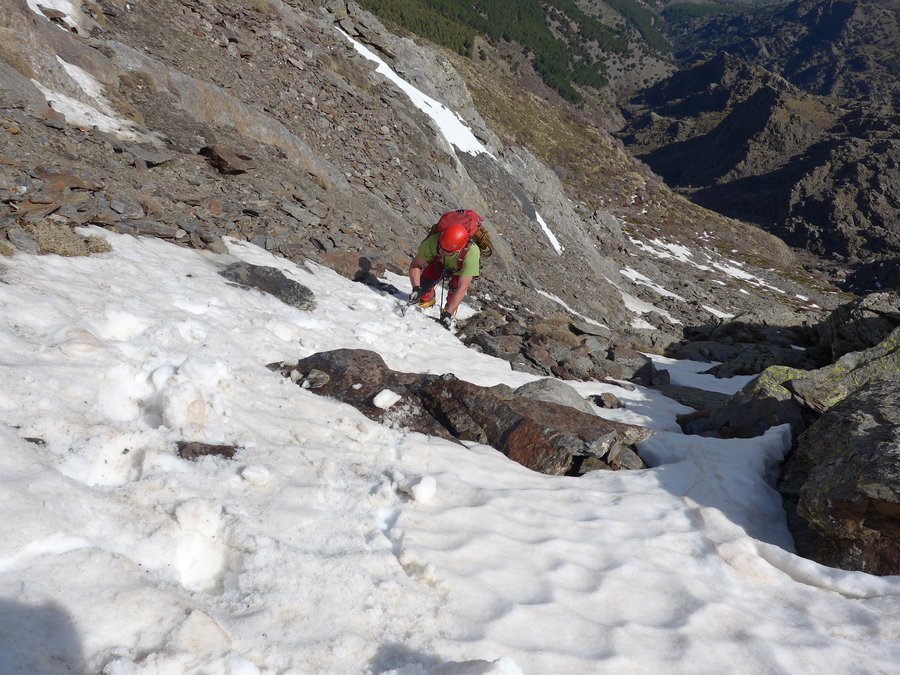
To the NE and SE of the summit area there exist some good lines of easy terrain eminently suitable for a beginner or those new to the sport.
Online Winter Mountaineering Guide to the Sierra Nevada, Spain
To the NE and SE of the summit area there exist some good lines of easy terrain eminently suitable for a beginner or those new to the sport.
Winter – PD
Approach from the Postero Alto hut (guarded) (3hrs). Climb is up the obvious couloir line. Plenty of belays available. Nice climb!
The first snows fall in November but realistically mountaineering doesnt get going until early December. The season last well into May.
The major snows fall in November/December and March/April. January and February have little preciptiation normally, just 2 or 3 bad days a month. Best ice is found, not unsurprisingly, in January, February and March.
With the advent of spring in early April, warmer temperatures and more daylight mean that snowshoes are often needed in the afternoons.
When we first arrived here in 2001 snow depths throughout the season were between 3 and 4 metres. Approaches were more arduous. The last 2 winters have produced less than a metre! Still fine for our sport though.
Average snow level is between 2000-2500m for much of the winter.
Not too much water ice climbing as you might expect in this part of Spain. There are some icefalls on the NE face of Alcazaba (1hr approach from Siete Lagunas) usually in condition and some higher streams and barrancos on the northern side form good ice.
The nearest place to do some ice climbing is at the Hoya de la Mora above the ski centre. You have a 25m walk to the fall which is located below and east of the green military bunkhouse. The ice is named appropriately “la cascada de los militares “. This is often 30m in height containing 4 or 5 routes. The icefall is actually formed out of the overflow from the bunkhouse water and sewerage systems! Not as nasty as you might think but keep away from the coloured ice on the far left looking up!
Protection: fixed bolted chain at a couple of points. We have utilised the bunkhouse railings but the Guardia Civil get a little exciteable off with this, but you can always find some natural protection further back with a bit of resourcefulness.
The icefall is popular with the spanish who can monopolise the available protection. Advice is to start early or finish late. We have actually climbed on into the night via headtorches, an eerie experience!
See the short video below called “Ice Climb 7000″ showing the ice climbing here.
The best and most accurate map around is the following:
Parque National de Sierra Nevada – La Alpujarra
Editorial Penebetica
1:40000
www.penebetica.com
ISBN: 84-933461-9-5
Winter – PD
1st Ascent – 12th April 1968

Approach – Either (a) start from the Albergues at Hoya del Moro (2,500m). Climb steadily north past the statue to the Virgen de las Nieves to the Balcon del Veleta (1½hrs) or (b) pay for a lift pass and take the Gondola and chair to below the Balcon del Veleta and walk from there (½hr). From here make an abseil or steep downclimb into the Veredon Superior, the key to the Corral de Veleta.
Winter – F
1st Ascent – Unknown
An easy traverse all above 3000m. Better if done in conjunction with the Tajos de la Virgen ridge.
Winter – PD to AD
1st Ascent – Unknown
Approach from Poqueira(2hrs), Viento (45 mins), Caldera (1hr) or Cariguela (1hr). Loads of potential for short routes. You will have to drop down one of the easier gullies, contour round before coming up one of the harder variations. Many lines exist. This is climbing of an exploratory nature!